

Faros and CataRhex 3 offer two pump systems: peristaltic and SPEEP pump, giving surgeons the flexibility to choose the fluidics principle that best matches their preferred technique.
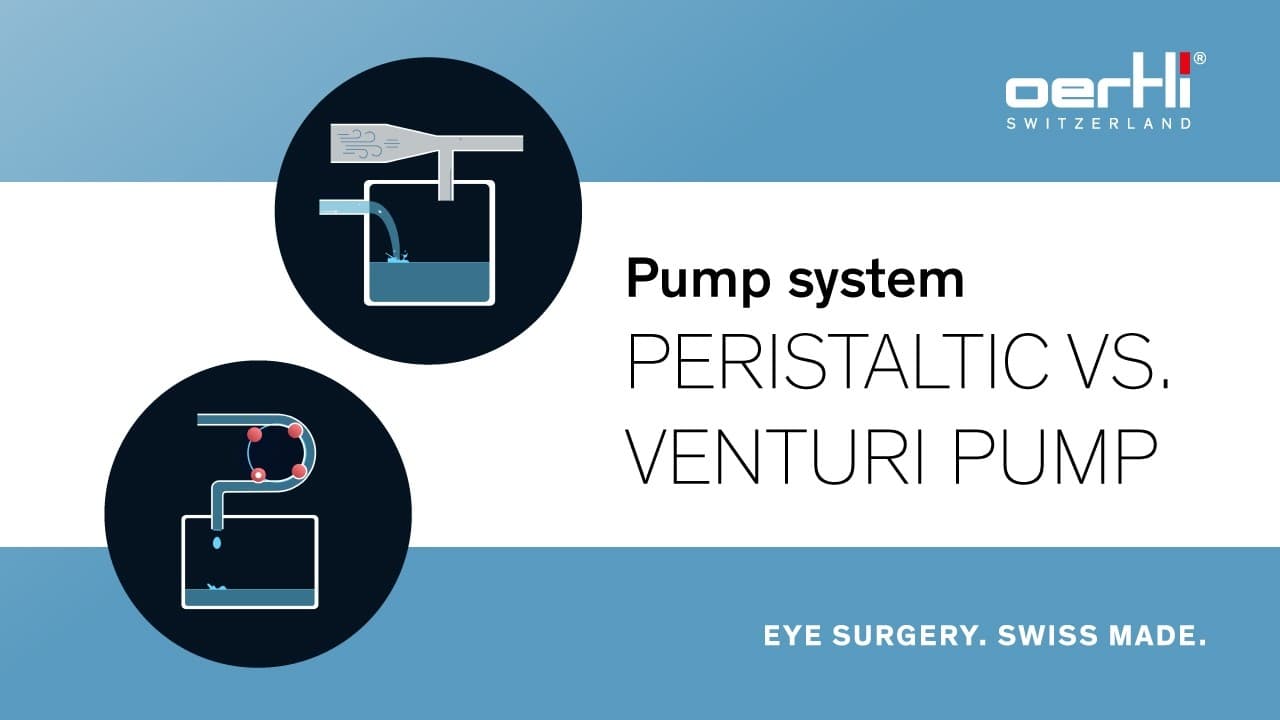
The peristaltic pump is flow-based, and though it can be finely tuned. The vacuum builds up by occlusion only up to the preset limit. Going a step further, the SPEEP pump combines the advantages of a flow-controlled peristaltic pump with the dynamics of a vacuum-controlled Venturi pump. Flow and vacuum can be controlled independently. This allows you to attract, precisely manipulate fragments and tissue, providing full aspiration control in free-flow and occlusion*.

Thanks to the standardised cassette type, you can switch quickly between peristaltic and the SPEEP pump. Also, available as a reusable cassette, it supports cost-efficient and sustainable workflows across anterior and posterior surgery.

«Simultaneous control of both vacuum and flow with SPEEP provides excellent stability and minimizes intraocular pressure fluctuations. Solutions for fluidic control, safety and cutting efficiency in Oertli's platforms allow rapid, secure and continuous progress for both junior and expert vitreoretinal surgeons.»D1
MD Anis Mahmoud
Taher Sfar University Hospital, Mahdia, Tunisia

Join Prof. Matthias Bolz for a crash course on pump systems. Learn the fundamental differences between SPEEP, Venturi, and Peristaltic pumps and discover how to choose the right system for your surgical needs.

Every procedure demands specific fluidics. From understanding linear flow to rapid vacuum dynamics, this video explains how different pump technologies impact your surgical procedures.
«As an existing Faros user I’m astounded what a step forward is achieved with the new Faros generation. With its new SPEEP pump, I’m able to increase my efficiency level again while reducing phaco energy and maintaining a safe environment at all time. The eyes of my patient truly look happy the next day.»D1
Dr Frank Sachers
Eye Center Train Station Basel, Switzerland

